Horrors of Consciousness
Is reality too much for humans?

Sometimes, when we are lying in bed at night looking at the dark, we have a creeping thought, "What am I here for? Why am I doing all of this?" These questions don't emerge in the moments of joy or sadness; they come to us in stillness, while washing dishes, standing in a line, or when you are walking on the road. They come to you when you are completely defenceless against them.
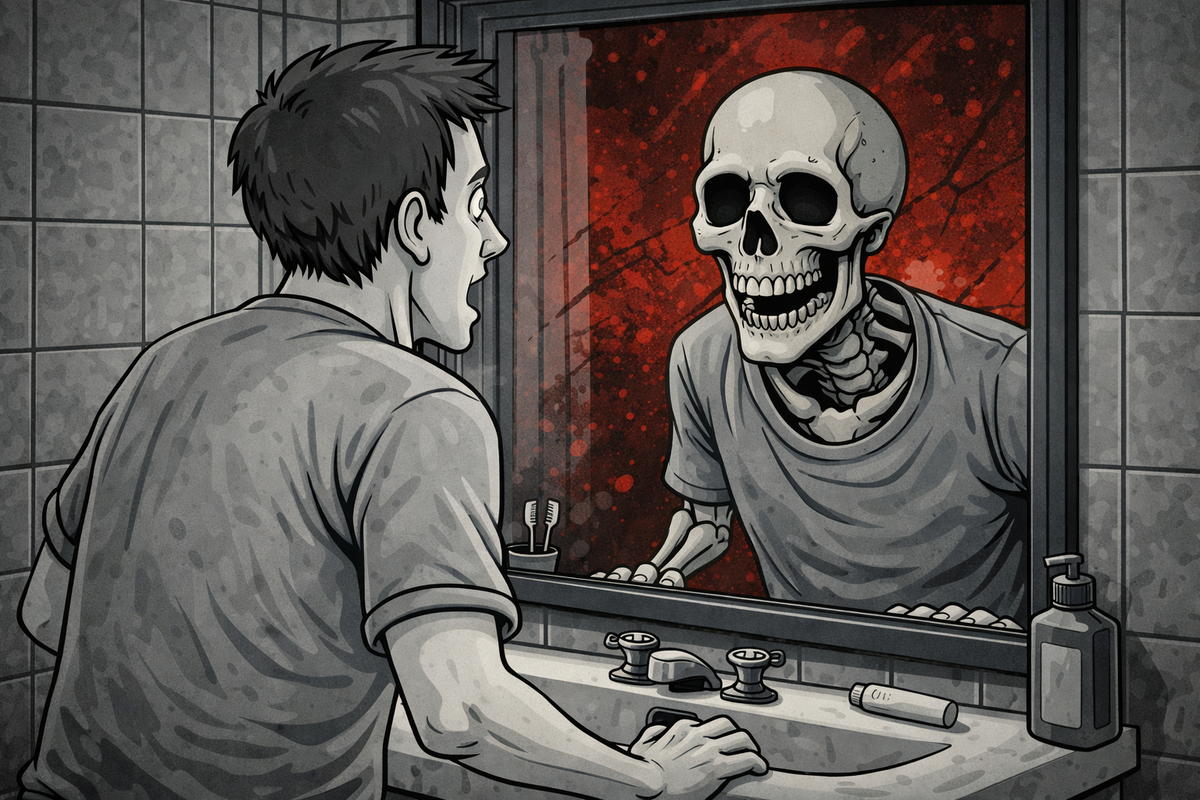
In those moments, you realise that everything that you see or feel will stop existing at some point, including you, whether you like it or not. You realise that every hope, dream, and meaning you have is nothing but a chemical reaction in the brain. It is like looking at a mirror, and for a moment, seeing the skull inside smiling at us, and beneath this skull lies nothing, nothing at all.
That is the horror of consciousness, the horror that the knowledge of our inevitable end makes us feel and our helplessness against it.
“When does a man become self-conscious? When he realizes he is food for worms.” - Ernest Becker
Why do we seek meaning?
Every living being has a fundamental instinct for expansion. Plants grow. Bacterias multiply. Animals reproduce. Life seeks to occupy more and more space in the world.
This instinct does not require any thinking or reflection. A tree does not wonder why it grows; it simply does.
Humans share the same instinct, but we are different from other living species. While other species cannot even notice their instinct, we can not only notice it but also realise that we cannot continue our physical expansion indefinitely; at some point, we will cease to exist.
Then our hunger for expansion becomes psychological; we seek to attach our name to things that will outlast our physical bodies. This is what we call our "legacy". Meaning is a justification of our instinct for expansion. We build civilisations, write books, explore space, and create art. In the hope that the universe will remember us long after we are gone.
If this is true, then our sense of control is questionable.
A puppet has no control in the environment it is born in, how it looks, is limited in what it can do, has a particular role to play, and depends on the puppet master to exist and move.
Humans are puppets being ruled by our instincts, and life is a puppet show without any audience, no one to watch or listen to this eternal chaos.
Cost of realising the horror
Most people can easily go on with their lives and distractions without paying much attention to reality. But some cannot look away, even if they try to; they keep looking at reality's horrors and go insane. Like looking at the sun with your eyes wide open and burning them.
Human consciousness has reached a point where it is unbearable for humans.
Self-awareness is often promoted as a critical ingredient for a successful and happy life. It is meant to help us lead a satisfying, fulfilling life and strengthen our relationships with others.
Then it should come as a surprise (or maybe not) that Buddha, arguably the most self-aware human being, had everything before becoming self-aware, gave it all up, and decided that living under a tree on dirt was better than having all the power, money, and fame in the world. He preferred suffering over lies and deception. That is what true self-awareness can lead to.
In 1910, a 23-year-old Carlo Michelstaedter published a thesis called ”Persuasion and Rhetoric” in which he said that all of us are lying to ourselves about reality. He argued that we should embrace reality as it is, we should not rely on external validation, and we should accept the fact that we are going to die and suffer while we live. He wrote that we are lying to ourselves that our lives have a grand meaning or purpose, and to prove this lie, we chase money, fame, and social security, none of which truly satisfies us.
On the day Michelstaedter finished his thesis, he shot himself in the head.
Our defence against the horror
Human perception is limited; we can only see a part of the world, and we construct our beliefs — whether true or false — to feel secure and safe in our environment. This limited perception of reality acts as a shield, preventing us from going insane.
If we try to see reality as it is, we become deranged.
“Let us love our limitations, for without them nobody would be left to be somebody.” - Thomas Ligotti
Norwegian philosopher Peter Wessel Zapffe, in his work “The Last Messiah” (1933), listed four strategies that humans use to cope with reality.
- ISOLATION: Humans push away the uncomfortable truths about reality, like death, meaninglessness, and the absurdity of existence, to avoid falling into desperation. Occasionally, we get a glimpse of those thoughts and feel the terror, but then we quickly pick up our phone and scroll on Instagram.
- ANCHORING: We attach our ego to different things (real or imaginary) as a way to provide meaning to our lives. These things can be like religion, nation, career, moral values, or family. The better we perceive these “things” to be, the better we feel about ourselves, and when someone attacks these “things”, we feel attacked.
- DISTRACTION: We constantly keep our minds distracted with something — entertainment, work, social media, hobbies — to avoid confronting the uncomfortable reality of existence.
- SUBLIMATION: In this rare form of coping mechanism, a person, instead of facing away from reality, consumes it and channels it out as a form of art or intellectual expression.
The result of those strategies is what we come to call "identity", a vital lie for us to feel safe and secure, and ignore reality. Which means that "me" that you keep referring to is an accumulation of defences you use against reality. Believing that your beliefs are the result of rational thinking rather than justifications for your gut feelings.
Optimists vs Pessimists
"Is life meaningless?" That is the biggest question for humanity to answer, and humanity has produced millions of justifications for any answer it came up with.
Existence is painful for everyone, and most of us don't want this suffering to feel meaningless. That is why humanity will never lack optimists, people who attach all sorts of meaning to the pain of existence.
Religious people have been calling this life a test, the result of which will decide whether we will go to heaven or hell. Most of the time, death and suffering are seen as an effect of some wrongdoing. Religious people have justification for all kinds of death, including the death of an infant ("Most have done something wrong in a previous life").
If you do everything right by religious standards, you will go to heaven. Each religion has its own version of heaven, but one thing all of them agree on is that existence on earth is not the ideal one. That is why heaven must exist; otherwise, it's all for nothing.
It is especially harder for people who do not take the shelter of religion. They have to rely on different tactics to avoid falling into despair.
There have been numerous books promoting "the power of positive thinking", selling millions of copies. Their core message is that we can lead a happy life by just thinking happy thoughts, and affirming to ourselves messages like "I love and approve of myself" or "I am happy". It is weird, then, that one book is never enough; they keep buying the next one.
Some people promote that meaning can be found in achieving success. By success, they mean money, fame, and power. They set different markers for success. Once they reach one marker, they move to the next one – as if playing a game which will never end. It will, for sure.
Some of us are too conscious of our denial. They cannot ignore the fact that they don't like this game of markers.
Pessimists are often seen as people too weak to deal with reality. But pessimism is not despair; it is a refusal of the lies. Pessimists ask whether the "meaning" constructed by the optimists is real or just an invention to tolerate reality.
Pessimism doesn't necessarily lead to paralysis. In fact, some of the best works in literature and philosophy were produced by pessimists. In their art, they don't reject life; they simply point out the realities of life.
For them, consciousness is the origin of all horrors; we wouldn't be suffering if we weren't aware of our suffering.
That is why some of them consider bringing consciousness into existence a grave mistake. According to them, we'd be passing on the curse that we feel to someone else, making them deal with suffering and eventual death. It is not surprising that many pessimistic writers didn't have a child.
Embracing Absurdity
Albert Camus, a French philosopher and writer, is famous for his work "The Stranger"(1942). He was big on embracing the absurdity of the universe.
Camus proposed a different response to this confrontation with meaninglessness. If human instinct cannot stop seeking meaning and the universe responds with silence, then the result is what Camus calls the absurd.
There are several ways people respond to the absurd. Some invent their own meaning, and others fall into despair. Camus rejected both; to him, they were a form of surrender, not to truth, but to our instinct for expansion.
"I don't know whether this world has a meaning that transcends it. But I know that I do not know that meaning and that it is impossible for me to know it. What can a meaning outside my condition mean to me? I can understand only in human terms." - Albert Camus
Instead, he proposed to embrace the absurdity. It means continuing to live, think, create, and love while knowing that none of it will last. When seen that way, the consciousness is not a form of horror anymore, it is freedom.
If we stop seeking meaning through our actions, then we perform the actions for their own sake, not with some ulterior motive.
He illustrated his point in his essay "The Myth of Sisyphus". Sisyphus is condemned by the gods to keep rolling a rock to the top of a mountain. Once on top, the rock rolls back to the bottom, and Sisyphus has to repeat the act indefinitely. Camus says that Sisyphus' true suffering is in his being conscious of how futile this activity is.
But what if, instead of suffering with the task, he accepts his fate and continues rolling the rock up the mountain anyway, he transforms his punishment into an act of defiance.
"This universe henceforth without a master seems to him neither sterile nor futile." - Camus